"Princess" A Mazda 323 like no other.

Crazycanadian

Greenie Member
Rather then cluttering up my Speed6 build thread I figured I would start a new one.

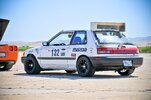
A little history. This 1993 Mazda 323 was owned by a close friend of mine (Rob). We met off a forum similar to this one after he got in over his head trying to rebuild the transmission for the car. We hit it off became friends and spent the next 8 years building our cars together and autocross racing. Unfortunately he passed away from complications during heart surgery in 2018. Life's thrown me a bunch of curve balls since 2018 so Princess has spent a lot of time in storage, but over the last couple of years I've been finding the time to enjoy her and carry on with some of the things Rob wanted to achieve with the car.

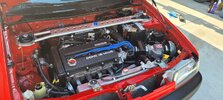
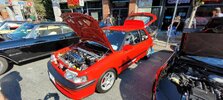
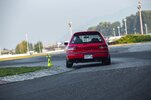
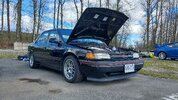
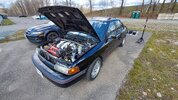
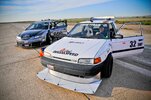
Princess in all her Glory.
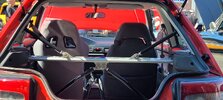
506993421_10163127515798701_4628764923655835288_n.jpg507165665_10163127162653701_1318826071986665493_n.jpg507973725_10163127515488701_7354657356446019157_n.jpg

For those Curious about the build details.

Styling department
JDM Protege GTX front bumper
Euro clear head lights and markers
GT-ae upper spoiler ( 1 of 200 made)
Familia grill
paint matched door handles and mirrors
Vintage Momo steering wheel

Current Engine/Transmission setup
1.8L DOHC BP swap (motor was rebuilt during swap)
Kia BP transmission case with closer ratio Mx3 gear set and 4.38 final drive. KAAZ LSD
Long since forgotten what brand of header. (Most likely Pacesetter), hand made stainless 2.5" exhaust with Magnaflow muffler
AWR Polly mounts all around
Custom made brass shifter bushings
Walbro fuel pump with Holley Hydromat used to combat the horrible fuel starvation issues these cars suffer from with the stock fuel tank. ( with 3/4 of a tank of gas it would fuel starve on long right hand corners)

Suspension/Brakes
K-Sport GT-Pro coil overs with custom spring rates
Polly front control arm bushings
Ford Escort Zx2 Front Sway bar
Big Addco rear sway bar
Ford Escort Zx2 lateral links with polly bushings
Custom made delrin subframe bushings
Pierce Motorsports tubular rear control arms
Pierce Motorsports Rear subframe brace
Pierce Motorsports Front 4 point subframe brace
Pierce Motorsports front and rear upper strut tower braces. The rear has optional upper pillar and seat bracing
Protege GT rear disc brakes, right now sporting some old school dimpled/slotted rotors and Hawk HP+ Pads
Goodridge braided brake lines

Wheels and Tires
True Version 1 Kosei K1's 15x7's
On order for this season are some 225/40/15 Vitour P1 (X-01R)

No details were spared when this car was being built. All the subframe, suspension, brackets, mounts everything got cleaned up, powder coated and restored.

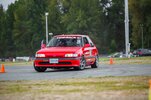
Originally built within old school FSP Autocross rules, the car used to be pretty competitive with out running on slicks. These days it's moved into XB where it's out gunned going up against light weight Miata's.
ee4d23cb05d80bd20cdf4eb7bce068c6.jpg8aa765d7818f7a86d7449200efe1a7f3.jpg

Last Summer my son and I enjoyed Autocross racing in it. We took it down the Packwood Washington for the National Tour event. We took it Canadian Nationals and most of the local events. I managed to run a couple of Time Trials events and took it to some car shows. It won a Judges choice award at one of them.

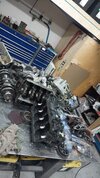
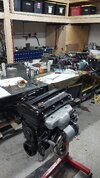
With my Sons Protege build finished it's been time for me to start working on Princess again. Maybe, just maybe I'll get this motor built and in the car before the Packwood National Tour event this July. Rob started this motor build 14 years ago. This is where I am going to geek out a little bit and unless you know, it wont make sense why.

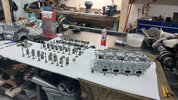
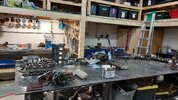
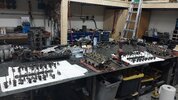
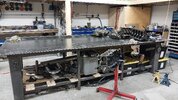
I haven't seen my shop bench look this clean in a long time. Don't mind this mess over in the corner. It's just a pile of 2 other BPT motors for a different project.
20260220_182215.jpg20260220_182226.jpg

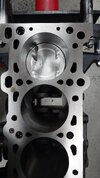
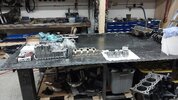
This is how Rob left things. 1 cylinder had been put together. Everything had been wrapped up and well protected.
20260220_185832.jpg20260220_182659.jpg20260220_185842.jpg

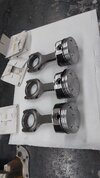
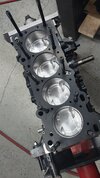
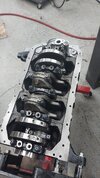
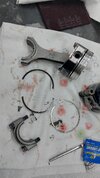
The motor build started out life as a BPD series 2 from Japan (This is a rare 323 GTR only motor). It was torn apart, the crank and block were sent off to the machine shop to get prepped for some ACL bearings, Eagle Rods and Weisco Pistions. A Boundary Bay Racing oil pump, and ARP hardware round out the bottom end.

It was a late night after work and I should have gone home. But I didn't and unforunatly broke while installing it. Thankfully I could get a replacement set direct from Weisco.
20260227_210509.jpg20260306_142245.jpg20260306_120539.jpg

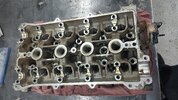
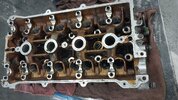
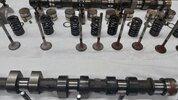
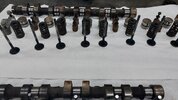
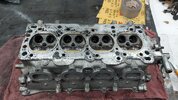
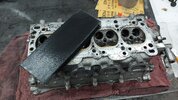
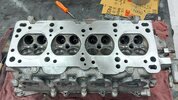
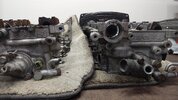
The BPD engine is special for a few reasons. One of them is cylinder head. It got a little extra love with the addition of sodium filled exhuast valves. As you can see I've got a collection of these motors so it took a little bit to go through all the casting numbers to find the correct one. While I was going through my collection I found a BP05 cylinder head from a Miata that had been rebuilt. Despite getting a little extra love the BPD head doesn't flow as well as the Miata cylinder head. So the BPD head got put away in favour of the BP05 head. It didn't take much to clean up, check over and reassemble the BP05 head since it didn't have many miles on it since it had been rebuilt.
20260219_184500.jpg20260228_125457.jpg

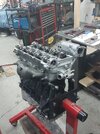
Most of the parts Rob had collected for this build have been scattered between 6 or 7 different bins. He was quite a detail orientated person, but at some point started getting overwhelmed by this project and knocking some things off his list before going in his surgery. So some stuff has been really well labled, and other stuff no so much. It's taking quite a big of time to find all the hardware and little bits and pieces. But I have found some fun goodies and managed to mock a few things up.
00a4c7a7-1b6a-4ddb-8983-ee2ce1d474a2.jpg

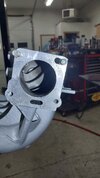
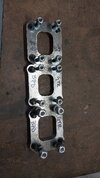
Rob was future proofing this build. I found a collection of adapters that will let me mount a T25 or T3 turbo on the stock manifold later on down the road. For now I'll be running the stock V23 turbo that was rebuilt back in 2012/13..
20260219_180030.jpg
 
Last edited:
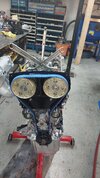
Pffffttt who needs Cam lock tools.. Some old school Toda adjustable cam gear and Gates racing Blue timing belt. Quick little did you know for those of you who've played with Miata BP's and 1.6Ls.... The timing belt tensioner spring is only used for setting belt tension. Once you've locked down the tensioner pulley you could toss the spring out. Also, proper tension is set by rotating the motor clock wise, watching the tensioner pulley. As you rotate the motor you'll see the tensioner move back and forth. When you get to a point where the tensioner has pulled the belt as tight as possible you lock down pulley.

20260307_193102.jpg

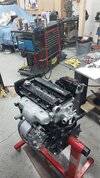
OEM 323 GTR Turbo Manifold with a very nicely polished and rebuilt VJ23 Turbo.. This was the stock "Big Boy" turbo back in the day. Yeee old double nut trick works great for installing or removing studs.
20260307_140117.jpg

A never used Cork Sport Down pipe starts bringing this build to life. For those of you who might know. Yes the down pipe has a horrible placement for the O2 sensor. This was a common complaint with these down pipes.

20260308_125737.jpg

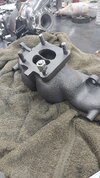
The intake manifold is one of the things that make this GTR engine special. The runners are staggered in order to balance out air flow to each cylinder. These manifolds are quite rare.
20260308_125801.jpg


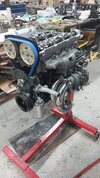
I can't wait to see this installed in the car and out in the sunshine. I decided the Intake manifold needed to match the valve cover. There's a red candy over top of the black that should add some character. It's a shame to cover up the Toda gears and timing belt with the cover. I have a spare cover I might drill access holes/windows in.

20260309_190255.jpg
20260309_190306.jpg

This is where the build stalls. I need to order an aftermarket 32-2 trigger wheel to bolt on the crank pulley. I've gotta find a good used Miata CAS to use for a cam sensor signal. Otherwise I'll have to come up with a way to use the stock distributor, and put a cap on it, kinda like Project Binky that looks good. I've gotta go to the junk yard and source some Toyota Coils for a COP conversion. Red top 450 cc RX7 injectors are out being serviced, hopefully they all get a passing grade. I wish I had a CNC machine or mill. I've got a custom throttle body adapter to build in order to make an ND2 throttle body fit. This will give me a proper IAC valve. I wont have to fight with tuning around the stock coolant controled high idle valve and "Idle up" valve that's not really designed to be modulated by a stand alone ECU. All though you can do it and it works. I've found cold start tuning tricky to get right. You can't really anticipate the high idle valve and how quickly it closes and when you need the idle up valve to start taking over.

With an ND2 throttle body I'll also have a proper 3 wire TPS sensor. The stock GTR/323/Protege/Escort GT TPS sensors are just a 3 position switch. Idle, part throttle and WOT. This wont work well with the Link G4X ecu I plan on running.
 
Last edited:
Well the motor build and dreams of having it installed before Packwood this year has quickly dried up. All 5 RX7 injectors I sent off for testing and cleaning came back with a bad bill of health. I can't afford a new set of ID or Deatch Works injectors. I do have 8 low impedance GTR injectors that could be flow tested and cleaned. But this would mean running the OEM resistor block and a batch fire injection, rather then sequential.

Time and energy is becoming an issue. I am in my 40s and can't do my 9-5 job then spend evenings and weekends in the shop the way I used to. I've gotta spend some time mapping out the suspension and re-thinking my alignment setup. If you know anything about suspension, you know this is going to take quite a bit of time to get right.

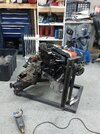
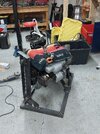
Sooooooo. whats the best way to start tackling all of this? Build a custom engine running stand... It still needs work, but it's a start.
1cb546e4-ac5e-47e8-ab63-8d0fcf0a0b47.jpg1cf2e910-189e-41b5-a0de-981c7525c472.jpg

This cleaned up my work bench so that I could start a 2nd motor build.
20260315_195558.jpg20260317_204508.jpg

I have a left over GTR head and a GTX head. The GTR head with it's fancy sodium filled valves was poorly taken care of. The cam's are a bit rusty from sitting. There's a fair bit of carbon build up. The GTX head is overall in good shape.

20260317_204538.jpg20260317_204532.jpg

When I tore both heads down it was interesting to see the exhaust valves from the GTX head are pretty red and white. They've been pretty hot. The GTR valves are black with a fair bit of really hard carbon build up on them
20260317_204520.jpg20260317_204527.jpg

After some careful inspection and checking, I've decided to run the GTR exhaust valves in my GTX cylinder. Since it's just an OEM valve swap between heads I can just lap the valves and make them work. I'll take a some flack for this, but don't really care. A very flat block of aluminum with some 400 grit sand paper works wonders to clean up the head gasket surface. Doing something like this takes a lot of care to keep from ruining the head.
20260320_185949.jpg20260320_190002.jpg20260320_190916.jpg

It was at this point my kid showed up at the shop Friday night. We had an autocross event to get ready for. By1230am, tired and re-thinking our life we choices we had some borrowed 15x7.5" 6UL's with 205/50 Bridgestone RE71's fitted to the car. This took fender rolling, alignment changes and inner wheel well stretching. All of the work paid off. The car felt amazing. I finished 15th overall out of 92 drivers.
20260321_135302.jpg20260321_135334.jpg

Here's my quickest run.
 
I am one of those weirdo's.. I don't drink, don't smoke, no weed or anything like that. Energy drinks put me to sleep. Gotta watch the pop intake otherwise I get waked out blood sugar issues..


Some days I think I'd be better off going back to drinking and my younger ways. I "felt" way better back then.
 
If those "younger ways" involved alcohol, then they felt better BECAUSE you were younger. Not because of the alcohol

I point that out because you led with the blood sugar statement.
 
Get the diabetes under control everything else will be easier once you do
I've been tested a couple times for diabetes, and thyroid issues. Both normal. It's possible I am having issues with hypoglycemia. Like any kind of issue like this, so long as I watch what I eat and drink things stay pretty even. Just means I live that boring life when it comes to food and drinks.
 
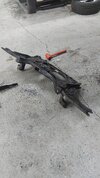
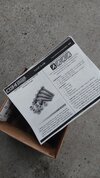
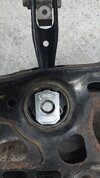
ADHD strike again.. Friday night I made a choice to get the cylinder head back together and stop the 2nd motor build. Saturday I had a side job to do for a friend of mine. We dropped the sub frame and installed a stiffer bushing for the dog bone mount, some 034 inserts and sub frame locking collars. This is H-street legal right? lol.. shhhhh, don't tell the locals.

20260328_124204.jpg20260328_124241.jpg20260328_125210.jpg

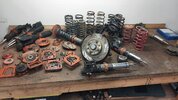
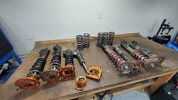
After my friend left it was time for a quick shop clean up before dragging my collection of old worn out coil overs and springs. I've got a problem with hording parts for a "rainy day".. Time to sort this junk out and start down sizing.
20260328_180313.jpg

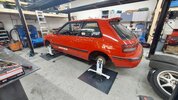
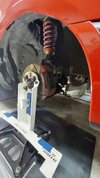
While I was at it, Princess went up on some hub stands so that I could start taking measurements and look for ways to improve my setup. One thing I've thought about doing is switching my 550lbs front springs from the front to the rear.. and taking the 420lbs rear springs and putting them on the front. I could get a little more wild. I've got some 600lbs springs and 800lbs springs. But I find I am often softening the front shock and making the rears stiffer.
20260328_175151.jpg20260328_175347.jpg

I've got some custom made spherical bearing inserts to install in the front control arms. This is going to help increase caster since the rear one is off set. I was hoping to get back at it today. The 225/40/15 Vitour P1X's I ordered are delayed. Which sucks, I need them in order to check fender clearances.

This weeks fun will be pulling the front and rear assemblies out, pulling the springs and putting everything back together. Then cycling the suspension in order to map out stuff like my camber curve, toe changes ect.. I've gotta look for a way to measure my SAI angle. Over the years I've run between 10 - 17 degrees with different setups. This angle doesn't get the kind of attention it should.
 
Those hub stands are really cool! I'm kinda jelly...

As light as that car is, it seems like the 600/800 combo might be a bit stiff, but you know what you're doing.

I'm just reading eagerly.
 
Those hub stands are really cool! I'm kinda jelly...

As light as that car is, it seems like the 600/800 combo might be a bit stiff, but you know what you're doing.

I'm just reading eagerly.
That's what I used to run on my old SMF car.. but I was running 15x10's with 275 wide hoosiers up front.. My real issue is the coil overs them selves. They are worn and desperately need to be rebuilt. Budget wont allow for it.. soooo it is what it is for this year.

SMF 323 Crows 2.jpgSMF 323 Crows 1.jpg
 
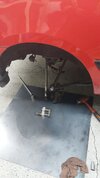
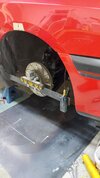
Before removing the front and rear suspension I took some important measurements in order to duplicate ride height. While I was at it, I checked the current alignment to get a base line.
Starting alignment.... Front Camber -3 deg, Caster 4 deg, toe 0 deg. Rear -2.5 deg toe 0 deg... Said previous SMF car had upwards of 7 deg caster. So I've got some work to do with this car.


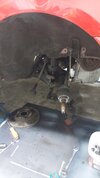
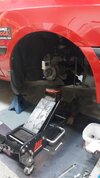
Let the madness begin. Out came the front and rear suspension on one side. This was done in such a way it wouldn't change my current alignment setup. The goal was to remove the spring and reassemble things and take measurements.
20260330_174014.jpg20260330_174029.jpg20260330_174056.jpg

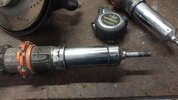
Step 1. Measure the shock stroke length. It's pretty simple, Put an O-ring or zap strap on the shock where the shaft meets the body when it's fully extended. After that compress the shock. Now measure the gap. In my case, these Ksport GTpros have a 4" stroke. 20260330_174102.jpg

Now time to reassemble and start the measurement process. I started with setting the hub to ride height as I previously measured. I made sure the car was levelled the jack stands, the same as it was when on the hub stands. This way my measurements are an apples to apples comparison. When doing stuff like this, it's the little details and repeatability of your testing that matters the most.

First up camber curve measurement. This where the low stance boy looks screws things up the most. With a Macpherson front strut design, there's a point where the control arm starts pulling the knuckle inward which reduces camber. From full droop to full compression I loose 1.70ish deg of camber.
20260330_180313.jpg

Next up.. Bump steer. Using my laser level and work bench, I marked where the laser hit my bench. From there I cycled from full droop to full compression. Once done, that high school math you never thought I'd used comes into play. I measured the distance from the marks to the laser. Then measured the distance between the marks. From there you can math out how many degree of movement you have. In my case it's about 1.7 deg of toe change.. specifically toeing out. This makes sense, some toe out during bump is going to induce some understeer. Manufactures want a car to have more understeer characteristics for safety.
20260330_193259.jpg

That's all for now. I've gotta come up with an excel sheet in order to track all of this.
 
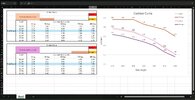
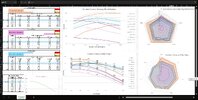
This week has been slow. But we do have some data. Before we get to the spread sheet and graph we've gotta dive into some technical stuff. Suspension dynamics is complicated and I am NOT and expert. My goal is to map out the dynamic camber curve, testing different steering axis inclination angles and caster angles. On a McPherson strut car, the upper camber/caster plates you install changes caster and camber by manipulating the SAI angle. This isn't always a good thing. But we'll get more into that later. Just like ECU tuning, suspension geometry has a bunch of overlapping things going on that you need to get right. It's easy to "fudge" it and make it work. Fudging it is what the majority of people and companies do when it comes to suspension. It works good enough the average person doesn't know the difference.

When it comes to this Mazda 323 BG Chassis, I am headed to uncharted territory here. After 15 years of racing these cars, I've never gone this deep into tuning the suspension. I've gone further then most would, but this is a whole new world.

For now a sneak peak at some data. We'll see if anyone can make sense of it for now and I'll come back later this weekend with some more pictures and information.
Suspension Camber Curve.jpg
 
Last edited:
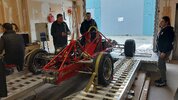
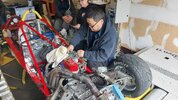
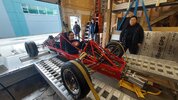
Friday I took a break from working on my car. It was a Dyno day for some friends of mine. They campaign a Formula Ford at our local track. On race weekends I work as part of their pit crew. You're looking at 40+ years of racing experience.

Things were going well during early break in runs. No power runs, just running the motor up and down slowly through the rev range, slowly working our way up higher in the RPM's
20260403_112013.jpg

It was running to rich, we were getting some misfires. Nothing serious at this point. Getting the carb adjusted and AFR's set right was the big reason for coming to the dyno. These cars don't run an alternator. They are basically running off battery power during their 20 min race's. There's also strict rules on what can be run in the car. So no data logging out on track. Getting something like the carb adjusted accurately isn't really possible during a race weekend.
20260403_123025.jpg

This picture was shortly before disaster struck. After the carb adjustments it was time for a little more break in, getting the motor up to it's red line at 6800rpm (not bad for a 2.3L Pinto Motor). Just before we were going to start doing some power runs all of the sudden there was a noise and the engine dropped a cylinder. We shut it down right away. There was a tapping noise from the top end so, off came the valve cover. We were hoping it would be a simple fix. Unfortunately we found cylinder #4 exhaust valve had issues. The push rod was bent, the lifter appears to be stuck in the bore. We don't know if it was a weak valve spring that caused some valve float, or a lifter that stuck in it's bore. But the exhaust valve kissed the piston and dinged the cylinder wall. There's still time to get this fixed and it looks like we can get it fixed so the season isn't over yet.
20260403_130945.jpg

Saturday I was back at my shop. Measure, Test, Adjust repeat. I changed up my approach to make sure my testing process was repeatable in order to be as accurate as possible.
20260404_161208.jpg

Lots of data was collected. More then whats charted here. I checked bump steer a couple more times both in the front and rear. Even played a little bit with the lower control arm and ball joint setup in order to better optimize the camber curve and adjust the roll center. I got some interesting results so lets dive in. Strut location 1 and 2 both reduce the SAI angle below the factory specs by about 2 deg. Strut location 2 reduces camber below factory specs. Strut location 3 in creases SAI angle and caster above factory specs. In all 3 tests I set the ride height and starting camber angle to the same spec. The SAI is the line drawn between the top of the strut shaft where it mounts and the center of the ball joint. This is traditionally show as following the shock shaft, but that's not always true.

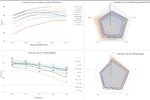
All right this a lot of data, so lets break it down into different pieces. Everything is color coded if you get lost just refere back to this picture.

Camber Curve Mapping.jpg
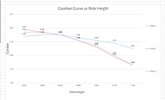
First up lets look at our Camber Curve vs Ride Height with the wheels pointed straight a head. As the wheel moves up and down, the control arm moves in an arc. As the control arm goes from being parrallel to the ground and sweep upwards it pulls the knuckle in wards. Since the upper strut mount is fixed, this causes the hub to tilt, reducing camber. When you lower your car, especially those of you who like the slammed life. This reduction in camber happens quicker due to where the control arm is in it's arc. (Hint, look at my rear Camber Curve, the control arm angle is horrible, look at how fast it drops off).

For those of use looking for real performance, control arm angles should be close to the top of your priority when it comes to ride height. That being said. When you get camber plates and tilt the strut in. This does help solve some of that problem. Now this graph is only showing how things work when the steering wheel is pointed straight.

Camber Curve vs Ridge height 0 deg.jpg

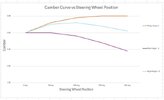
Next up lets set up at ride height and turn the steering wheel. Since most racing is done below 1 turn of the steering wheel, this is as far as I went. This is where things get interesting and become harder to visualize. At this point Caster starts coming into play since it's part of the SAI angle. An increase in caster in creases camber gain as the steering wheel is turned. An increase is SAI angle decreases camber gain as the steering wheel is turned. Take a look at the difference betwee Ride Height 1 and Ride Height 2. This show cases how important caster is when it comes to camber gain while turning.


Camber Curve vs Steering wheel position at ride height.jpg

At this point we've zoomed in on a couple of key points. To get a bigger picture we need to zoom out and bring in more data points and get rid of some irrelivent data. At this point more caster is going to be a must, so I'am going to stop looking at Strut mount location 2. It's worth noting. All though I am talking about zooming out to get a bigger picture. I am only looking at whats going on when the suspension is compressing when turning left. I am not looking at how it would be acting when unloaded in a corner. This is where things get complicated and interesting. When we are in strut mount position 1 we get the most camber gain while the wheel is turning, but at the same time we get the most camber loss as the suspension compresses. When setup in strut mount position 3 we loose quite a bit of camber as the steering wheel turns, but we also loose the least amount of camber as the suspension compresses. I took a bump steer measurment when I was setup in strut position 3. It was reduced by half a degree or so. What does this mean? Lot's, but non of it will give you a direct answer as to whats the best setup. All of the Camber.jpg

There are some key take aways. More caster is a good thing (To a point). To much caster will make your steering heavy and difficult to control. Increasing the caster is going to tilt the knuckle and change the location of your steering arm. I haven't talked about this, but it'll have an effect on bump steer. Tilting the strut to increasing your SAI angle can help, but it's something I'd avoid if possible. It will also have an effect on bump steer. Watch how low you go. Once your control arms go past being parrallel to the ground at ride height you end up killing your camber curve and performance.

Next up, I'll be taking a closer look at the rear suspension.. Welllll, actually I've all ready taken a closer look at the rear suspension, but I need to take pictures to put the story together. I've got some bump steer issues going on back there as well to solve.
 
Last edited:
Back
Top